

What is ATSTAR?
Assistive
Technology
Strategy
Tools
Accommodations
Resources
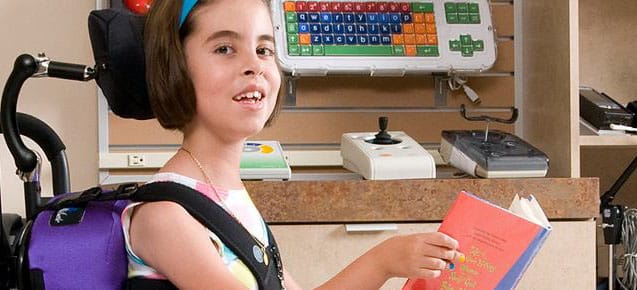
ATSTAR is an online curriculum designed to improve educational outcomes for students with disabilities by helping teachers learn to use assistive technology in the classroom. ATSTAR prepares instructional staff at the school level to conduct assessments, collect data, and integrate assistive technology into the educational process. The program provides a network of ongoing support as educators learn to use technology to include students with disabilities in classroom learning activities.
How can ATSTAR help me?
ATSTAR has something for everyone who wants to find more opportunities for students with disabilities:
- Administrators. How do you know your teachers are up to date on the tools their students with disabilities could use? How well do your teachers work as a team to stay on top of the latest developments? Learn how ATSTAR helps teachers become a team as they learn about AT and how ATSTAR lets you track their progress.
- Teachers. What tools are available today to help you reach students with disabilities--and to help them let you know what they have learned? In a series of online lessons, ATSTAR will show you how assistive technologies can break down barriers to communication. And you don't have to do this alone. ATSTAR helps you build a team with your colleagues. With ATSTAR in your toolkit, your students will have better educational outcomes.
- Parents. If your child's teachers had access to ATSTAR, what more could they do for him or her? Learn how you can help us reach the teachers and administrators in your schools. If you need more help than you've been getting, we can help you find an agency or organization in your area that serves parents of children with disabilities.
Enroll
You can enroll as an individual immediately on this website:
Individual Enrollment $50
Request Group Pricing by E-Mail:
Group Enrollment $60
About Knowbility

Knowbility is a non-profit based in Austin, Texas. Knowbility's mission is to support the independence of children and adults with disabilities by promoting the use and improving the availability of accessible information technology.
We envision a world of barrier-free information technology in which children, youth, and adults with disabilities have greater options to learn, work, and fully participate as producers and consumers in the information marketplace.
Assistive Technologies Definitions
The Individuals with Disabilities Act of 1997 (IDEA '97) defines assistive technology with these words:
300.5 Assistive Technology Device
...any item, piece of equipment or product system, whether acquired commercially off the shelf, modified, or customized that is used to increase, maintain or improve functional capabilities of children with disabilities.
If you take a closer look at this definition, it really has two parts. An assistive technology device…
- is an item or piece of equipment
- which, when used, increases functional capabilities
Almost anything can be considered assistive technology if a person with a disability needs it to increase, maintain or improve the way he or she functions. Assistive technology devices are often referred to as assistive technology tools. Here's a list of reasons why people with disabilities might use assistive technology tools.
- communication
- managing the environment
- hearing and listening
- moving their bodies
- working with numbers
- play
- reading and writing
- to help them remember
- to help them see
- help them work
Another way to look at the question of what is assistive technology is to ask what the tool would do for a person. Here's some things assistive technology commonly does:
- Increases levels of independence
- Improves quality of life
- Increases productivity
- Enhances performance
- Expands educational/vocational options
- Increases success in regular education settings
- Reduces amount of support services needed
What are Assistive Technology Services?
IDEA '97 also tells us that there are services that must be provided to support a person's use of assistive technology. Everyone needs some help when they begin to use a new tool for the first time. Here's what IDEA '97 has to say about assistive technology services:
300.6 Assistive Technology Service
Any service that directly assists an individual with a disability in the selection, acquisition, or use of an assistive technology device. Such term includes:
- Evaluation: the evaluation of needs, including a functional evaluation, in the child's customary environment
- Providing Devices: purchasing, leasing or otherwise providing for the acquisition of assistive technology devices
- Selecting, Repairing: selecting, designing, fitting, customizing, adapting, applying, maintaining, repairing, or replacing of assistive technology devices
- Coordinating: coordinating with other therapies, interventions, or services with assistive technology devices, such as those associated with existing education and rehabilitation plans and programs
- Training and Technical Assistance - Child: training or technical assistance for an individual with disabilities, or where appropriate that child's family
- Training/Technical Assistance - Professionals: training or technical assistance for professionals, employers, or other(s) who provide services to, employ, or are otherwise, substantially involved in the major life functions of children with disabilities
When is the use of Assistive Technology Appropriate?
Assistive technology is any tool or device that a student with a disability uses to do a task that he or she could not otherwise do without it or any tool the student uses to do a task more easily, faster, or in a better way. It can be a commercial product or something someone makes. It can be a simple "low tech" device such as a pencil grip or an expensive "high tech" device such as a computer.
Assistive technology has the powerful potential of impacting significantly upon a student with disabilities by contributing to his or her learning, independence, self-esteem, and quality of life. The only way to truly know whether assistive technology will make a significant difference for a student is try it out. For instance if a student is struggling with getting meaning from printed text, the IEP team may think that the student will benefit from having text scanned into a computer and spoken. The only way to determine if this will work is to try it. If the student has never tried the assistive technology, the IEP team should write the trial use of the technology into the IEP, rather than the purchase or permanent acquisition of the assistive technology.
You can enroll as an individual immediately on this website:
Individual Enrollment $50
Request Group Pricing by E-Mail:
Group Enrollment $60
ATSTAR Expert Advisors
Throughout product development, ATSTAR ensured that the Quality Indicators for Assistive Technology (QIAT) were strictly adhered to by thoroughly integrating six of the nation's lead thinkers in the area of assistive technology into the curriculum development process. ATSTAR's key consultants are:
- Gayl Bowser, is the former Coordinator of the Oregon Technology Access Program (OTAP) and an independent consultant. Ms Bowser provides assistive technology consultation, training and technical assistance throughout the United States and internationally.
- Diana Foster Carl, M.A., L.S.S.P., is a Licensed Specialist in School Psychology in Texas with more than 30 years’ experience in various capacities in public education. Currently, Diana contracts with CAST as the Special Projects Coordinator for the National Center on Accessible Instructional Materials.
- Carye Edelman, Assistive Technology Specialist, Austin Independent School District
- Kelly Fonner, has a BS in Special Education and an MS in Educational Technology with emphasis in Rehabilitation/Special Education Technology. Her continuing education and research has been in the area of Adult Education and Special Education Technology. She is an independent educational and assistive technology consultant.
- Terry Lankutis, is an independent assistive technology specialist from Montana with a focus in the integration of assistive technology in rural settings.
- Jan McSorley, has over 20 years of experience in K-12 as a teacher and as an Assistive Technology Specialist. She is currently leads the accessibility effort at Pearson's School Division.
- Penny Reed, is the former Director of the Wisconsin Assistive Technology Initiative (WATI). She has been a teacher, consultant and administrator in the field of special education and assistive technology and the author of numerous publications about assistive technology services.
- Joy Zabala, Ed.D., ATP, is a general and special educator who has worked with students, families, education agencies, and others across the USA and abroad for more than 25 years to expand the use of assistive technology. She is the developer of the SETT Framework and currently serves as the Director of Technical Assistance for CAST and the National Center on Accessible Instructional Materials.
ATSTAR is an acronym which stands for Assistive Technology: Strategies, Tools, Accommodations, and Resources. It is a collaborative partnership comprised of educational professionals in Pre-K to 16 settings, technology experts, curriculum specialists, and leaders in the field of assistive technology. The central goal of ATSTAR is to build a National Collaborative Network to ensure that people with disabilities have equal access to technology-enriched education and competitive employment opportunities. ATSTAR promotes the utilization of promising approaches and technology innovation relevant to the needs, issues, and trends affecting people with disabilities.
ATSTAR also engages in the research, development and piloting of innovative parent and teacher training initiatives to improve social, educational, and vocational results. The ATSTAR Collaborative is an organization that sees opportunities where others see obstacles.
The accomplishments of the ATSTAR Program demonstrate our partnership's ability to coordinate successful, national collaborations and to complete innovative and high quality products, against tremendous odds, and under tight timelines. In an 11-month period, the ATSTAR Program accomplished the following:
- Designed, and developed an innovative, interactive, CDROM/web-based curriculum for teams of campus personnel
- Established mission-critical partnerships with organizations that train and employ adults and students with disabilities
- Designed and produced a web portal of assistive technology resources that meets the highest standards of accessible multimedia and web design, including the W3C Standards
- In addition to making the user-end of ATSTAR materials completely accessible, the program collaborators have been working to make the system administration software for the ATSTAR web portal completely accessible as well. The purpose in making the system administration software for the ATSTAR web site completely accessible is to ensure that people with disabilities can be employed to maintain the Center's web-based resources and manage the Center's web portal.
Background
The ATSTAR program was initially developed with a grant from the Texas Education Agency through their Technology Integration in Education (TIE) grant program. The grant was awarded to the Austin Independent School District (AISD) and development of ATSTAR was a collaborative effort between AISD and the following six agencies: The Austin Community College, The University of Texas at Austin, Austin Harvard School, Sylvan Learning Center, Far South Community Schools, and Region XIII Education Service Center.
The grant effort produced a CD and web-based assistive technology training model designed to prepare instructional staff at the campus level to conduct assessments, collect data, and integrate assistive technology into the instructional setting. The grant participants included 56 public school personnel on 14 separate campuses and 2 private school personnel. Training was delivered to approximately 640 educators and has impacted over 1,800 students. Additionally, in the 2004-05 school year 30 districts in Central Texas participated in the pilot.
In 2005, Knowbility took over full ownership of the ATSTAR curriculum, further developed an administrative tracking engine, and updated the curriculum.
ATSTAR - for Assistive Technology Strategies Tools Accommodations and Resources - is an series of 8 learning modules for teachers, parents, and other stakeholders in the education of students with disabilities. It is designed to improve educational outcomes for students with disabilities by helping educators learn to use assistive technology in the classroom. ATSTAR prepares instructional staff at the school level to conduct assessments, collect data, and integrate assistive technology into the educational process.
There is a $50.00 enrollment fee per student. Contact atstar@knowbility.org for group pricing.